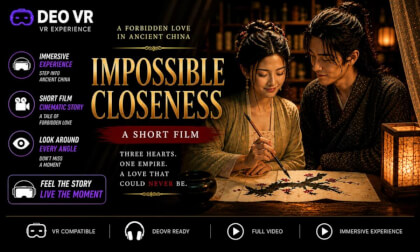
A painter falls in love with a woman he can never truly know, discovering that the deepest forms of closeness are often those that cannot be seen.
Short Synopsis (FilmFreeway)
Set in a poetic world inspired by the Tang Dynasty, Impossible Closeness follows Shen Mo, a blind painter whose extraordinary talent allows him to capture the souls of others despite never seeing their faces. When he meets Yue Ning, their growing bond inspires a series of paintings that blur the boundary between imagination and reality, asking whether true love depends on sight—or something far deeper.
Long Synopsis
Can we truly know another person?
Set against the elegance of a Tang Dynasty-inspired world, Impossible Closeness tells the story of Shen Mo, a gifted blind painter whose art reveals emotions invisible to ordinary eyes.
Unable to perceive physical beauty, Shen Mo paints what he senses within the people he encounters. His life changes when he meets Yue Ning, whose quiet compassion awakens emotions neither of them can fully express. Their relationship unfolds through shared conversations, fleeting encounters, and paintings that gradually become windows into an inner world beyond vision.
As political expectations, personal sacrifice and the limitations of the physical world begin to separate them, Shen Mo discovers that the deepest intimacy may exist precisely because it can never be possessed.
Blending traditional Chinese aesthetics with cutting-edge AI filmmaking, Impossible Closeness is a lyrical meditation on love, perception, memory and the invisible threads that connect human hearts.
Director’s Statement
I have always been fascinated by the paradox that people can stand beside each other every day and still remain strangers, while others become deeply connected despite distance, silence or even never truly seeing one another.
Impossible Closeness was born from that paradox.
Although the film is set in a world inspired by the Tang Dynasty, it asks timeless questions about human relationships. How much of another person do we actually perceive? Are our deepest connections formed through appearance, or through empathy, imagination and shared experience?
The protagonist’s blindness is not presented as a limitation but as another way of seeing. Through his paintings, he discovers truths that sighted people often overlook. His journey became a metaphor for how art itself can reveal invisible emotions.
This film also represents my exploration of AI as a cinematic medium. Rather than using artificial intelligence simply to create beautiful images, I wanted to use it to express profoundly human emotions. Technology becomes the brush, but the heart of the film remains deeply personal.
Ultimately, Impossible Closeness is about the invisible spaces between people—the places where longing, memory and love quietly exist.